
The greatest challenge in designing AI assistants today isn't a lack of knowledge—it’s an excess of it. Between fragmented sources, rapid technological shifts, and contradictory best practices, research can quickly become a risk rather than a foundation for decision-making.
In a recent client project, we faced a typical challenge of modern UX work: How do you develop reliable design guidelines for AI assistants when the market is fragmented, sources are inconsistent, and technology is evolving at breakneck speed? Our focus was specifically on dialogue-based AI assistants, aiming to go beyond general UX principles to derive practical, evidence-based recommendations. It soon became clear that the originally planned approach wouldn't suffice.
Consequently, we rebooted our research: systematic, source-based, and supported by AI tools—without sacrificing critical human judgment. This article outlines how we structured this process, how AI accelerated our research, and why the combination of technical support and professional context is crucial for creating resilient design guidelines.
From Scenario to Knowledge Base: Why We Started From Scratch
Initially, the guidelines were meant to be derived directly from customer journeys we created in a preliminary project. However, these described very specific usage scenarios and proved too narrow to formulate universal recommendations for AI assistants. The consequence: a methodological restart.
The Research Reboot: Breadth First, Then Depth
We drew on existing research (including official AI guidebooks from Google, Microsoft, and Amazon) and supplemented it with classic desk research: best practices, press materials, and field reports from specialist articles and YouTube. The goal was a realistic market overview.
While initial insights provided orientation, they remained at a high level of abstraction. To achieve more depth, we utilized the deep research capabilities of Perplexity, ChatGPT, and Google Gemini. Our central prompts focused specifically on recommendations for using AI assistants.
Key Learnings:
With Perplexity and Gemini, the source lists proved significantly more valuable than the generated summaries.
With ChatGPT, we occasionally encountered hallucinated sources—here, extreme caution was required.
All validated sources were then consolidated centrally in NotebookLM.
Precision Through Structured Prompting
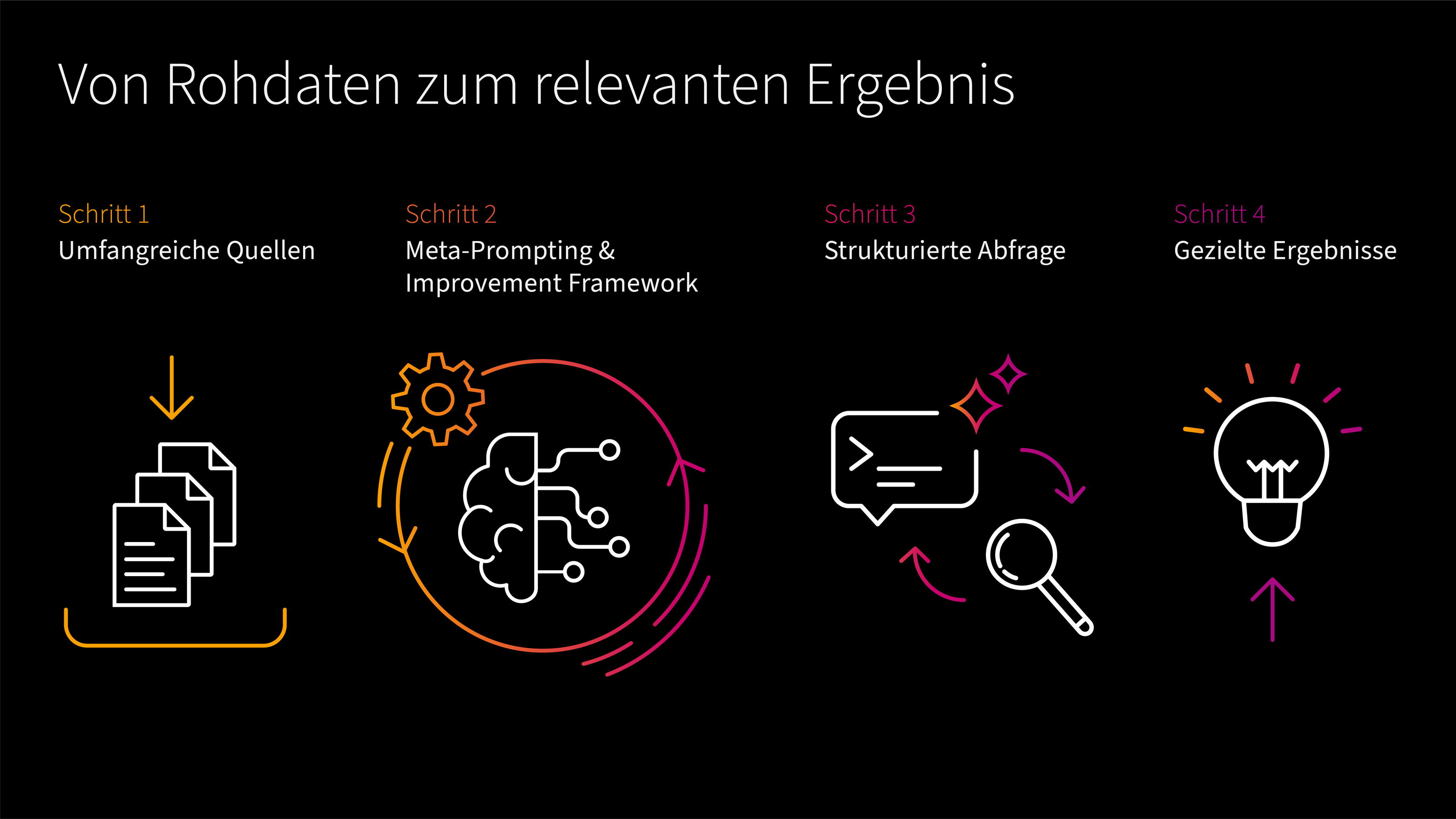
To extract targeted answers from the extensive source base, we employed Meta-Prompting. This approach provides the AI with context awareness and guides it to think more structurally, critically question its own answers, and deliver more relevant results. An "Improvement Framework" helped systematically sharpen prompts regarding task specificity, context, clarity, and accuracy.
The optimized prompt was used to query the collected sources in NotebookLM and generate a comprehensive list of relevant findings.
Note: Meta-prompting is a helpful tool, but not an end in itself. As LLMs continue to mature, it will likely become optional—however, critical thinking remains indispensable.
Where Human Judgment Remains Essential
The insights gained were manually filtered, structured, and tagged with clear citations. Professional inquiries from the client played a central role here, helping to verify hypotheses and sharpen context-specific aspects. These inquiries were fed back into targeted queries of the source base. This created an iterative dialogue between humans, AI, and data—with clear human accountability.
In the next step, the extensive research results were translated into understandable, applicable guidelines. Again, NotebookLM provided support by integrating the previous analyses as additional sources. A specific prompt helped prepare the content consistently according to a fixed pattern:
Brief summary
Methodology / Principles
Do’s & Don’ts (with strict character limits)
The AI output served exclusively as a starting point. The final elaboration was done manually to avoid generalizations and incorporate project-specific requirements.
During this process, it became evident that certain UX principles were repeatedly confirmed. These were defined as an overarching introduction and referenced within individual guideline sections. The selection of appropriate visual metaphors to illustrate the guidelines was
Results & Learnings
The result is not a loose collection of recommendations, but a consistent, traceable guide that translates complex findings into a manageable format for design and product teams.
Core Value Add:
A robust basis for decision-making instead of information chaos.
Clear separation between proven insights and assumptions.
A shared understanding between the project team and clients.
Project Best Practices:
Always combine AI research with critical source verification.
Never adopt LLM summaries without checking them.
Actively involve clients in refining hypotheses.
Build guidelines iteratively and modularly.
The developed guidelines form the foundation for further concept and design phases and can be continuously adapted to new technological developments. This project exemplifies how deep research in design can be significantly accelerated by AI—provided that human expertise, methodological discipline, and critical thinking remain central components of the process. This is precisely where we see the sustainable strategic value for our clients.
Interested in strategic Deep Research for your next project?
Let’s connect to discuss how our mix of human expertise and AI acceleration can create a solid basis for your strategic decisions.